Friday 24 July, the last day of the deadline
President Karol Nawrocki signed the Polish AI systems act on Friday 24 July 2026, on the last day of the twenty-one-day deadline under Article 122 of the Constitution. The same day, the presidential chancellery announced the signing of five acts, and the AI one passed through those announcements almost unnoticed — alongside an amendment banning the tethering of dogs.
The point is that this is the act that closes a two-year story: one that began in the autumn of 2024 with a bill from the Ministry of Digital Affairs, stood still for several months because of a dispute with the Ministry of Finance over who would pay for supervision, and was unblocked only by the compromise reached in February 2026.
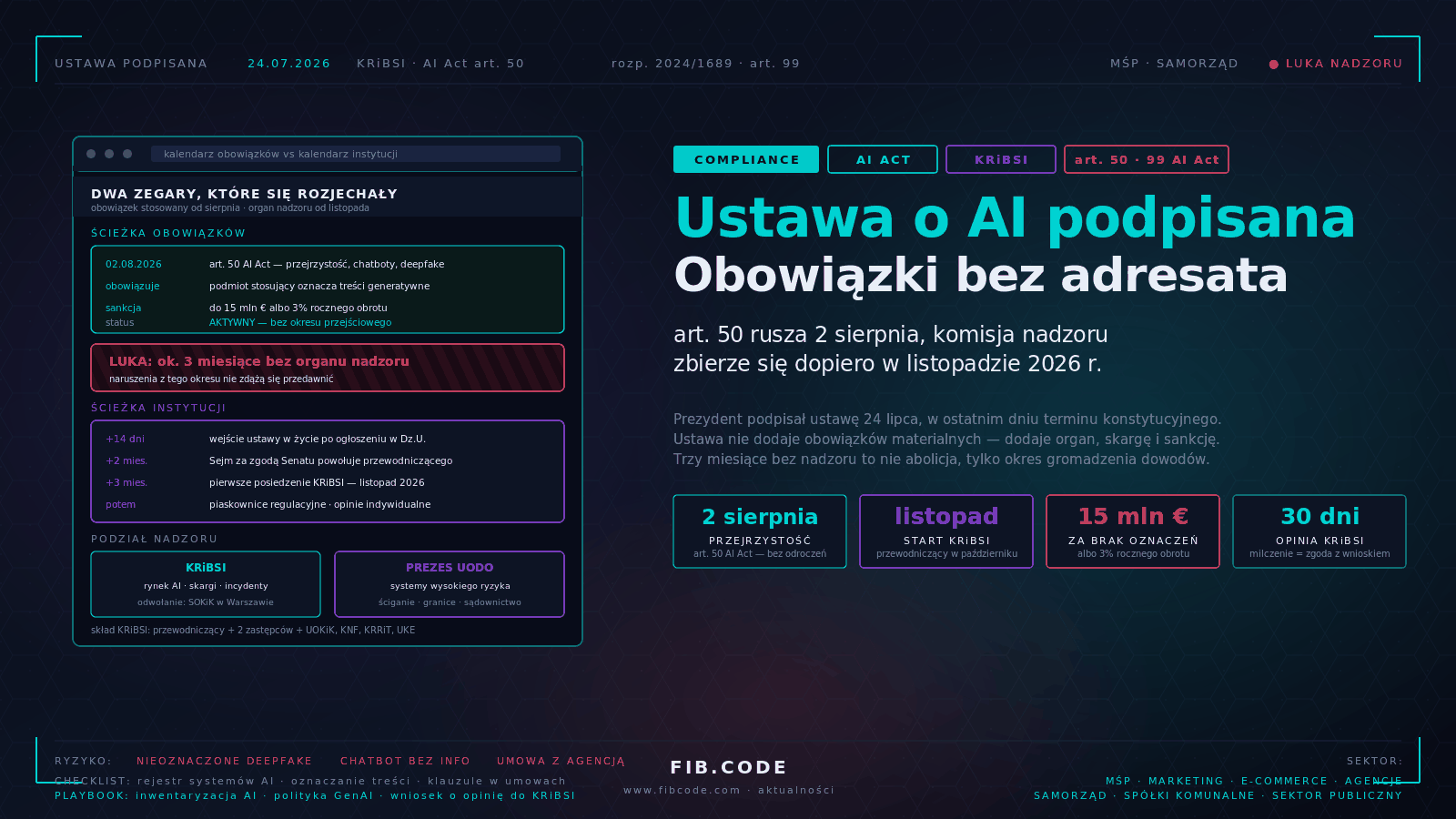
The signature means publication in the Journal of Laws, and most of the provisions will enter into force fourteen days after promulgation. From that moment two clocks start running: within two months the Sejm, with the Senate's consent, is to appoint the chair of the Commission for the Development and Security of Artificial Intelligence, and within three months the chair is to convene its first sitting.
Dariusz Standerski, deputy minister for digital affairs, translates that into a calendar without hedging: a chair in October, the Commission working from November.
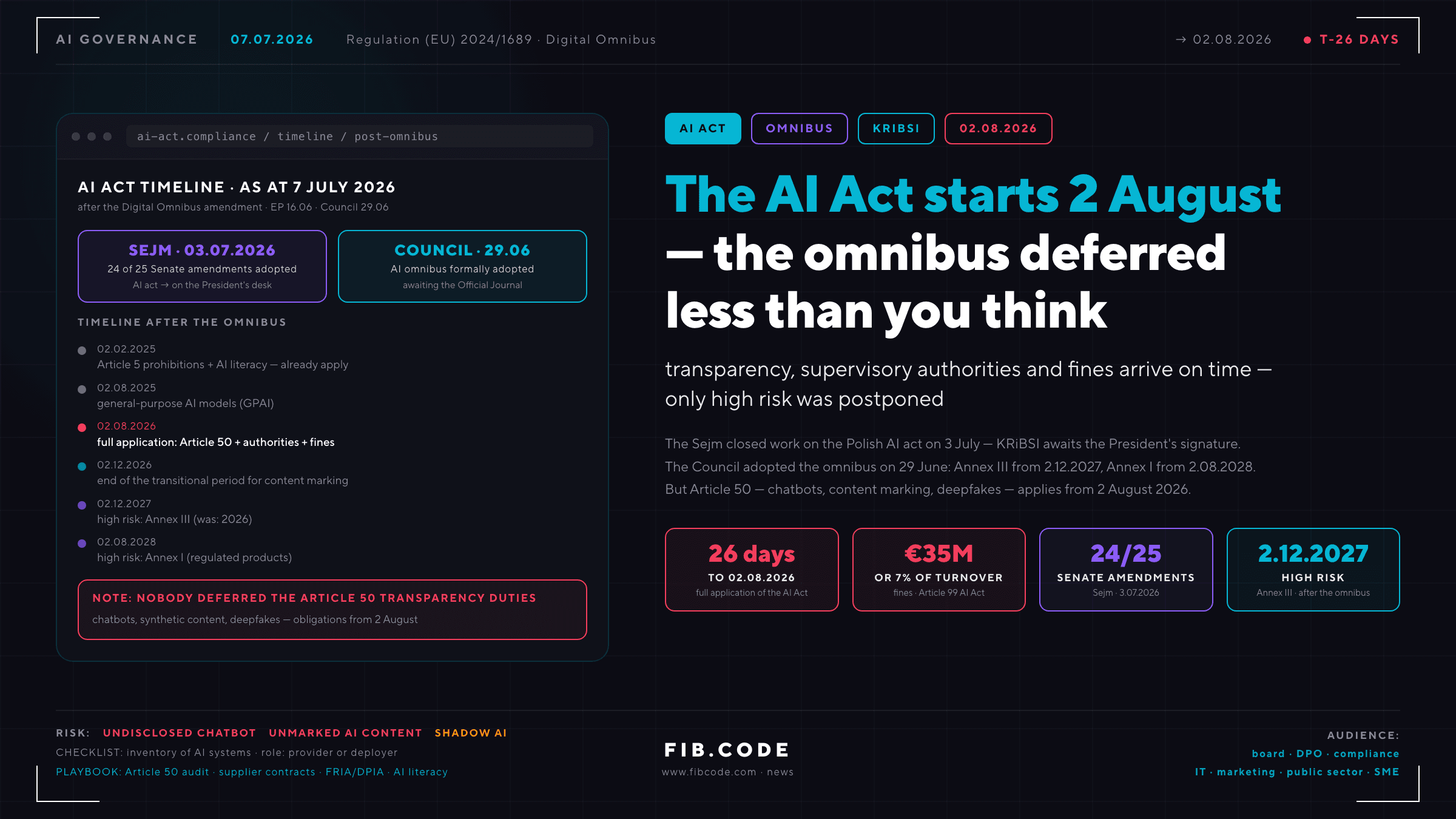
Meanwhile, on 2 August 2026 — that is, in five days' time — the AI Act's transparency provisions become applicable. The gap between the calendar of obligations and the calendar of institutions therefore runs to about three months. Many businesses will read that gap as a protective period. That reading is wrong, and in a moment we will explain why it is also expensive.
What the act adds, and what it does not change
Let us start with a misunderstanding that has been repeating itself in commentary over the last few days: that only now, after the President's signature, will companies become subject to the AI Act. No. Regulation 2024/1689 is a directly applicable act and has been in force in Poland since 1 August 2024, and successive packages of its provisions take effect on their own timetable, independent of what the Polish parliament does.
The prohibited practices have applied since February 2025, the obligations of providers of general-purpose models since August 2025, and transparency — from 2 August 2026.
The Polish act does not change a single point of substance. It does not redefine an AI system, it does not modify the catalogue of obligations, and it does not introduce documentation requirements of its own.
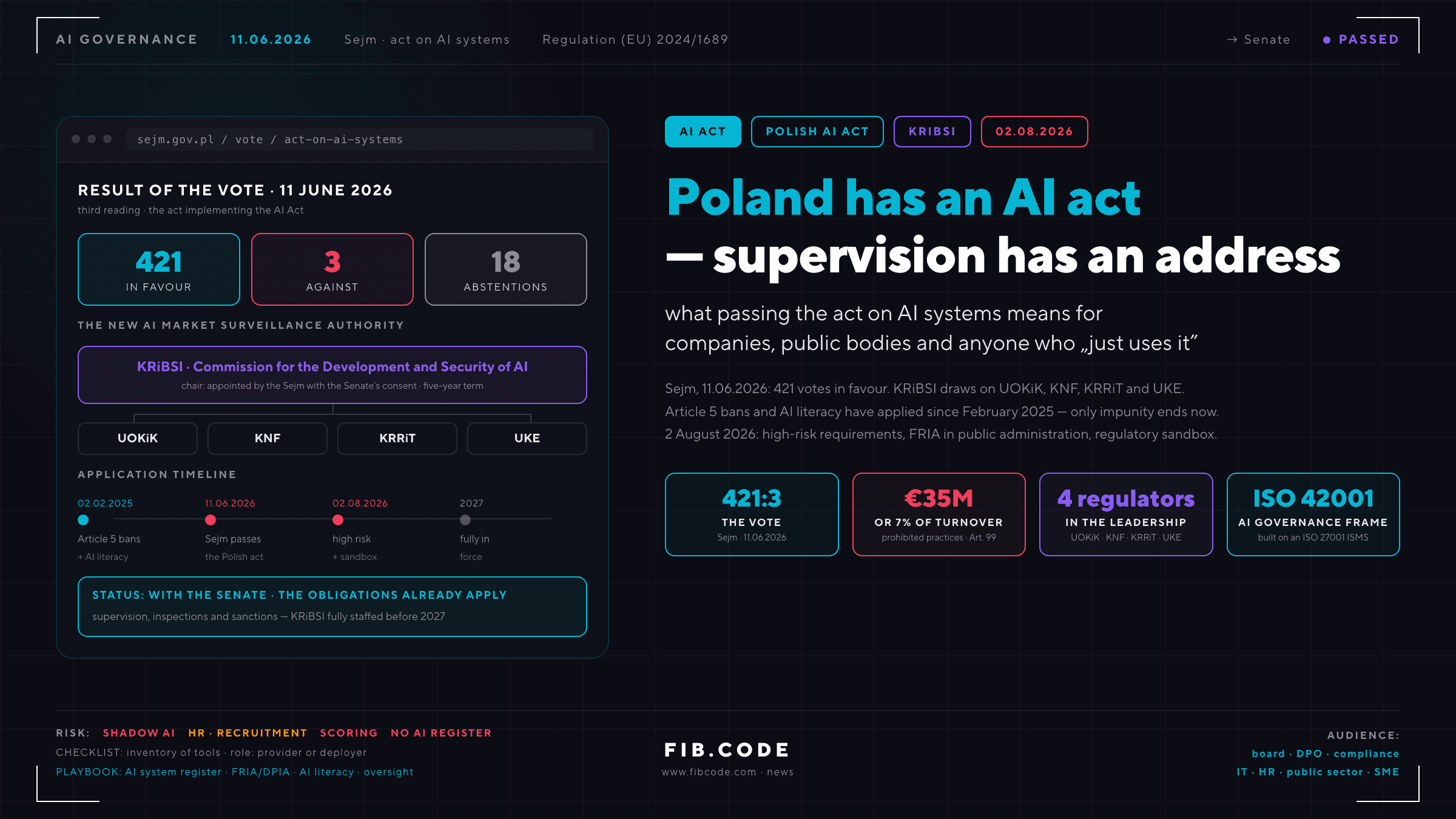
As Dr Paula Skrzypecka, a specialist in new technology law, aptly put it, the act means that the AI Act's provisions "will genuinely acquire teeth" — because a supervisory authority will start to operate. The act is in essence an institutional statute: it builds a body, assigns competences, and designates procedures and an appellate court.
In other words, on 24 July companies did not acquire a single new obligation. What they acquired was an addressee. Somebody who, from November, will receive a complaint, issue an opinion, carry out an inspection and impose a fine. For the past two years the AI Act in Poland was a regulation with no telephone number to ring — and no telephone that might ring back. The second half of that is now changing.
Three months with nobody to turn to
The most important sentence in this article is this one: the absence of an authority does not suspend the running of an obligation. Tomasz Zalewski, an attorney-at-law specialising in new technology law, put it precisely when commenting on the content marking obligation — formally it starts to apply on 2 August 2026, and even if KRiBSI gets going later, any infringements are unlikely to become time-barred in the meantime and will still be open to penalty.
That changes the character of those three months from a protective period into a period of accumulation. A company that publishes unmarked AI-generated material between August and November enjoys no amnesty whatsoever. It is simply building — day by day, campaign by campaign — a body of evidence that will be waiting the moment the authority starts work. In the case of marketing content that evidence is additionally public, archived by search engines and reconstructible down to the date.
It is also worth noting who can make use of that evidence earlier than the regulator. A competitor who concludes that an unmarked generative advertisement gave somebody an edge has the Act on Combating Unfair Competition at its disposal and does not have to wait for the Commission to be appointed.
A consumer who felt misled can go to the consumer ombudsman or to UOKiK. A candidate rejected by an automated recruitment system can lodge a complaint with the Polish data protection authority (UODO) under Article 22 GDPR — and that route works today, with no transitional period at all.
A complaint about an AI system — a channel that did not exist before
The act introduces a procedure that simply did not exist in the Polish legal order: a complaint about an infringement of the AI Act or of national provisions. A citizen who considers that an artificial intelligence system has infringed their rights will be able to notify the Commission. The proceedings may not last longer than six months and end in a decision against which an appeal lies to the Warsaw Regional Court sitting as the Court of Competition and Consumer Protection.
That choice of court is significant, and it says more about the legislature's intention than many a substantive provision. SOKiK is a court that has spent two decades deciding cases in competition protection, telecommunications and market regulation.
Placing appeals against KRiBSI decisions there positions AI supervision closer to a market regulation regime than to the administrative proceedings that dealings with UODO have accustomed companies to. In practice that means a different evidentiary standard, a different judicial culture and higher procedural stakes.
On top of that comes a second channel: reports of serious incidents. The Commission will receive them and, where there is a direct risk to life, health, safety or fundamental rights, will be able to order that use of a system cease or that it be withdrawn from the market.
For a company that has built its customer service or its production process on a single AI tool, that is an operational risk, not merely a financial one. A fine hurts, but an order to switch a system off in the middle of the season can cost more.
Two authorities over one system
The act does not hand the whole of supervision to KRiBSI. The President of UODO becomes the national-level authority for market surveillance of high-risk artificial intelligence systems used in law enforcement, border control and in the area of justice and democracy. KRiBSI itself is to be responsible for the placing on the market of high-risk systems and for creating regulatory sandboxes.
The division has a logic to it — where an AI system touches fundamental rights and personal data directly, supervision goes to the authority that has been building competence in precisely that area since 2018.
The overlap with GDPR stops being a theoretical problem and becomes a single set of proceedings: a data protection impact assessment and a fundamental rights impact assessment can be run as one process, and the case law built up around Article 22 GDPR and the CJEU judgment in Case C-634/21 SCHUFA is ready-made interpretative material.
The risk lies elsewhere, and Eliza Turkiewicz of the Lewiatan Confederation has identified it: businesses must not be exposed to repeated inspections or to conflicting interpretations concerning the same AI system. With five regulators present in and around the Commission — UOKiK, the KNF, the KRRiT, UKE and UODO as a separate supervisory authority — that is not a hypothetical worry.
A company selling one tool to a bank, to a broadcaster and to a public authority may, in an extreme scenario, receive three different positions. There is only one practical answer: the system's documentation has to be good enough that each of those authorities reads it the same way.
A deepfake is also the tomato in a supermarket leaflet
Let us turn to what will actually hit Polish SMEs on 2 August. The obligation in Article 50(4) of the AI Act requires deployers to disclose that content has been artificially generated or manipulated where it meets the definition of a deepfake. And this is where the thing most businesses have missed begins.
Until May 2026 it was widely believed that this concerned content depicting something that really exists — a specific person, a specific event. The European Commission's guidelines overturned that reading: content does not have to depict real people or objects; it is enough that it resembles realistic objects.
Zalewski gives examples that, in Polish commercial practice, sound like an ordinary Thursday to-do list: an AI-generated tomato in a shop's advertising leaflet, a realistic visualisation of a flat with generated furniture in a developer's brochure, a video with a synthetically generated voice-over. Each of those three requires marking. A drawing of a dragon does not — because dragons do not exist.
The test, moreover, is conducted from the recipient's perspective, not from the creator's intention. And it is not the average recipient who counts but the person the message is addressed to, which calls for particular care with material aimed at children and at older people.
The line runs roughly where quality improvement ends: sharpening a photograph or correcting its colours does not require marking, whereas changing proportions, or any other far-reaching modification that creates a false impression of authenticity, does.
There is an exception for text, but it is a narrow one. The obligation does not cover informative text that has been subject to human review or editorial control, where editorial responsibility for the publication is borne by an identified natural or legal person. Artistic, satirical and fictional works are treated more leniently — a mention in the closing credits is enough, instead of a badge on the image itself. Advertising and business material gets no such concession.
Who does the marking: the agency or the brand
There is a gap in this provision worth recognising before the first campaign after 2 August. The disclosure obligation rests on the entity deploying AI to create the content, not on whoever then distributes it. If an advertising agency generates material for a well-known brand's campaign, the marking obligation falls on the agency, not on the brand. A social media platform is under no obligation to mark AI output — its user is.
The brand should not, however, conclude from this that the subject does not concern it. First, the Commission's guidelines encourage entities distributing content generated by others to preserve existing markings — and a regulator's encouragement has a habit of hardening in inspection practice.
Second, the absence of marking may trigger liability on an entirely different footing, an act of unfair competition among them, and here the claim will be addressed to whoever benefited from the advertisement. Third, in reputational terms nobody excuses themselves successfully with the sentence "the agency was supposed to mark it".
The practical consequence is contractual, not technical. Every contract with an agency, a production studio or a freelancer signed after 2 August should contain a representation as to whether, and to what extent, AI systems were used in production, an undertaking to mark the output in accordance with Article 50(4), and a liability clause covering the consequences of a breach.
That is one page of text, worth drafting once and pasting into every contract — and its absence can cost up to EUR 15 million or 3% of annual turnover, because that is the upper limit of the sanction for breaching the transparency obligations.
Fines: two rates and the state budget
It is worth putting the amounts in order, because they circulate as a single large number that makes an impression but explains nothing. The AI Act provides for three levels of sanction, and the Polish act does not change their size — it merely designates the authority empowered to impose them and settles that the proceeds from fines will go to the state budget.
The highest level, up to EUR 35 million or 7% of total worldwide annual turnover, applies to the prohibited practices in Article 5 — social scoring, manipulation exploiting vulnerabilities, untargeted collection of facial images from the internet and emotion recognition in the workplace.
That level concerns a minority of companies, but that minority usually does not realise it belongs to it — tools analysing employee mood in surveys, or systems assessing the reliability of counterparties, can come closer to the line than the procurement department assumes.
The middle level, up to EUR 15 million or 3% of turnover, covers infringements of the remaining obligations, including the transparency obligations in Article 50 — that is, precisely what starts to apply on 2 August. That is the real rate for a company that does not mark its generative material.
The third level, up to EUR 7.5 million or 1%, concerns supplying the authorities with information that is untrue, incomplete or misleading — in other words, the situation in which a company mishandles the proceedings themselves.
That third rate tends to be dismissed, and in practice it is the most insidious. An infringement of Article 50 requires a conscious decision not to publish the marking. An infringement consisting in misleading the authority can be committed through sheer inattention — by sending, in response to a request, a register that does not reflect the actual state of affairs because nobody has updated it for six months.
A fine for a mess in the documentation is the same species of risk as a fine for the infringement itself, only cheaper to avoid.
Individual opinions and tacit consent
The act gives businesses a tool that receives little attention and that may in practice prove the most valuable of all. A company will be able to apply to KRiBSI for an individual opinion on the application of the provisions. The Commission is to issue it within 30 days, or within 60 days in particularly complex matters. If it misses the deadline, the opinion will be deemed to have been issued in line with the position set out in the application.
This tacit acceptance rule is a solution of considerable practical value, as the Lewiatan Confederation stresses — companies gain the ability to confirm in advance how the provisions will be applied in a specific case, instead of learning the regulator's position only during an inspection or after a decision.
For an entity planning an investment in an AI solution of unclear classification, a binding answer within 30 days is the difference between budgeting and guessing.
There is one caveat, but an important one: the tacit acceptance mechanism does not cover the special opinion a participant may request after completing its participation in a regulatory sandbox. There the act disapplies the rule.
It is also worth remembering that in its first months the Commission will be recruiting staff, so the real time taken to handle applications in November and December may diverge from the statutory model. Anyone with a classification question worth money should have the application ready before the Commission opens its inbox — not start writing it in December.
A sandbox with no pilot phase, free for SMEs
The second tool is the regulatory sandbox — a controlled environment for testing AI systems in direct contact with the regulator. The Ministry of Digital Affairs has abandoned the pilot phase considered earlier, under which businesses would have had access to only some of the functions for the first six months.
Launching it is expected to take about three months, and companies will receive the full range of services from the outset. Participation by micro, small and medium-sized enterprises will be free of charge.
Entry to the sandbox will be decided by a competition, the terms of which KRiBSI will publish. Under the preliminary assumptions, an application is to include a technical description of the system, information about the product and about the planned scope and reach of its use, with the individual elements scored on points and a limit on the number of places.
The Ministry says it will devote the next three months to information activities — the preparation process is to start immediately after the act is published in the Journal of Laws.
In fairness it should be added that sandboxes have their critics too. Dr Paula Skrzypecka concedes that she does not question their premises, but says she has not come across a project that genuinely gained momentum from taking part — and points out that for typical business applications, verifying a project against real customer needs will be more effective.
She does see real value in one scenario: building a system for the public sector, where the sandbox serves not only for testing but also for learning the rules of communication with a public authority and its procedures. For vendors of solutions for local government, that is a pointer worth remembering.
Local government: the council chatbot and the clash with 3 October
The public sector enters August with a double burden. On the one hand, the transparency obligations: an authority that has put a chatbot serving residents on its website must, from 2 August, inform the user that they are talking to an AI system.
An authority that generates graphics for its social media communications falls within the marking obligation — and will not benefit from the exemption for personal activity, because a local government unit's communication activity is by definition professional.
On the other hand, 3 October 2026 is the deadline for applying for entry in the list of essential and important entities, for most entities that met the criteria on the day the amended Polish NIS-2 implementing act (the KSC Act) entered into force.
For many municipalities and municipal companies this means that in the same quarter they have to close out NIS-2 self-identification, prepare for the first administrative decisions once the six-month transitional period expires, and on top of that put in order the question of AI tools used in the authority.
Our recommendation for local government units is simple, and it follows from arithmetic rather than from caution: these two processes should be run by one team and on one asset register. The inventory of systems that has to be carried out for KSC purposes anyway, with one column added — "does the system contain an AI component, and in what risk class" — serves both regimes. Running them separately, with two teams and in two spreadsheets, doubles the work on the same factual base.
The register that should be created in August
Everything described above comes down to a single document that most Polish companies still do not have: a register of the AI systems used in the organisation. This is not about a thirty-page form.
It is about a spreadsheet recording, for each tool, who deployed it, which process it operates in, whether it generates content published externally, whether it takes or supports decisions concerning natural persons, what data goes into it and who in the company is responsible for how it runs.
That register solves four problems at once. It answers the question of whether 2 August concerns us at all — and it usually turns out that it does, through marketing, which nobody had thought of in compliance terms. It marks the boundary of shadow AI, that is, of tools brought into the company by employees without the IT department's knowledge, which we have written about separately.
It is the starting point for an application for an individual opinion, because without a description of the system there is nothing to ask about. And finally — it is the first document an inspection will ask for, regardless of whether it comes from KRiBSI, from UODO or from UOKiK.
The deadline is comfortable, because a register can be built in a week and the nearest real examination falls in November. The problem is that companies which do not start in August will not start in September or October either — and in November they will be doing it under the pressure of the first letter.
Why work with Fib.Code
Fib.Code runs compliance projects at the meeting point of three regimes that begin to overlap from August: the AI Act, GDPR and the KSC Act.
We serve as data protection officers and information security officers, we run ISO 27001 audits and ISMS implementations, and for the past two years we have been building an AI governance practice — system inventories, risk classification assessments, transparency documentation and policies on the use of generative tools.
Our approach rests on three principles. We start from the facts, not from a template — first we establish what the organisation actually has and does, and only then do we select the documents. We do not multiply regimes where they can be combined — one asset register serves the KSC Act, GDPR and the AI Act, provided it has been designed properly.
And we leave the client documentation that its own team can maintain after we have gone, because compliance that nobody in the company understands stops working a quarter after handover.
The end product is always the same: a complete set of documents ready to be produced for an inspection, roles assigned to named individuals, a review schedule, and a list of the things we deliberately do not do, together with the reasons. That last item is often the most valuable, because in proceedings a documented decision not to do something is worth more than silence.
What to do this week
Five working days remain until 2 August, and they are enough for one meeting and one spreadsheet. Call an hour-long meeting with the person responsible for marketing, the person responsible for IT, and the data protection officer or the information security officer.
The meeting's task is to answer four questions: which AI tools are used in the company, which of them generate content published externally, who signs the contracts with the agencies and subcontractors producing that material, and who is responsible for the marking from 2 August.
Three things should come out of that meeting by the end of the week. A spreadsheet register of AI systems, even a preliminary and incomplete one. An addendum or a clause for contracts with agencies, covering a representation as to the use of AI and an undertaking to mark output in accordance with Article 50(4) of the AI Act.
And one decision: whether the company will prepare an application to KRiBSI for an individual opinion before November — and if so, who writes it and by when.
Get in touch: l.grabowski@fibcode.com | fibcode.com/en/contact. Directly related material: The AI Act kicks in on 2 August — what the omnibus really postponed, The Sejm has passed the AI act — time for an inventory, AI in recruitment — GDPR, UODO and high-risk systems (in Polish) and Shadow AI — the invisible employee — four texts that together form a complete picture of what a company should have in order before November.