Friday 3 July, the morning voting block
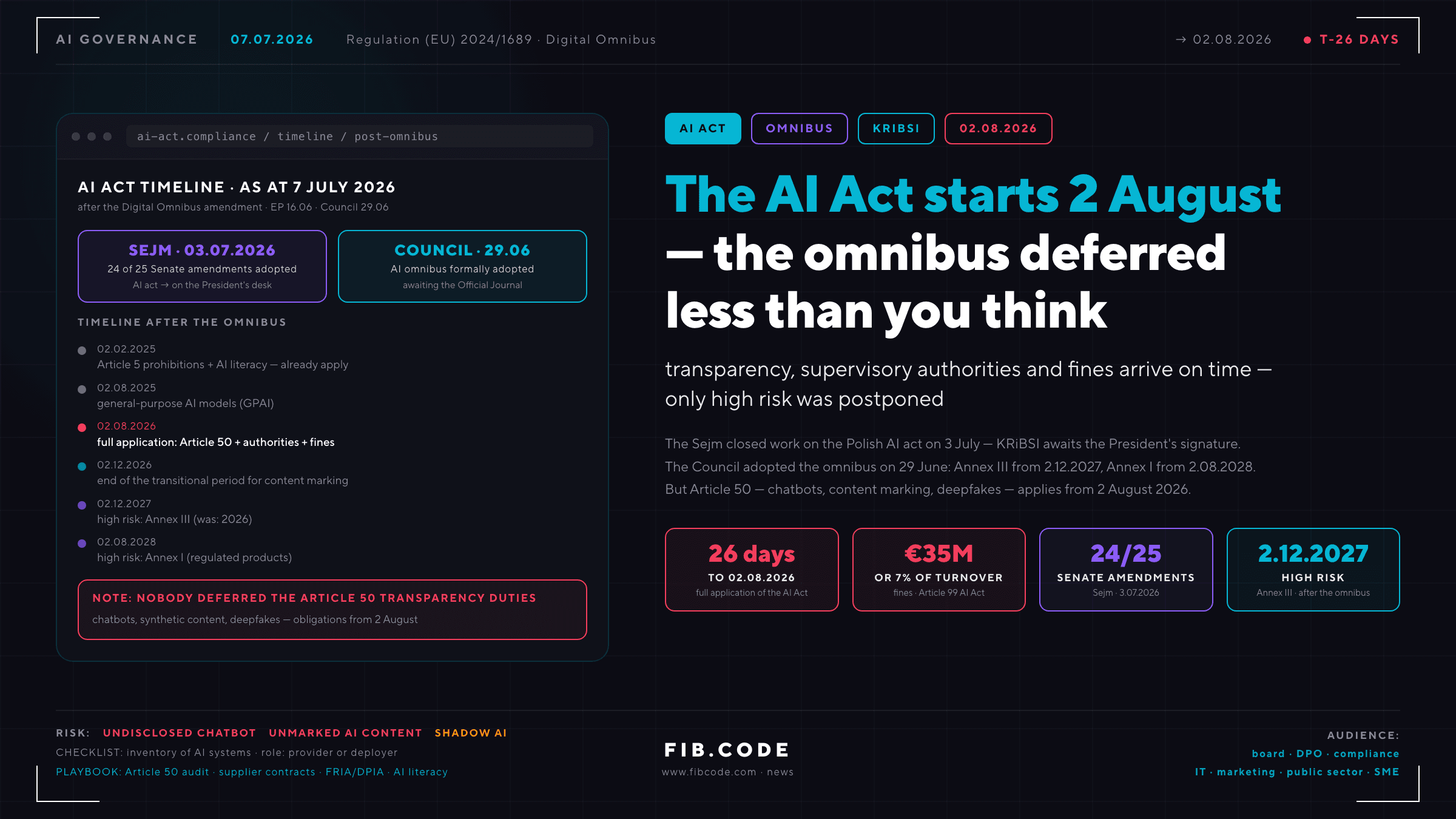
On Friday 3 July 2026, in the morning block of votes, the Sejm considered the Senate's resolution on the act on artificial intelligence systems. Grzegorz Napieralski MP, rapporteur for the Committee on Digital Affairs, Innovation and Modern Technologies, recommended adopting twenty-four of the twenty-five Senate amendments — and that is exactly how the chamber voted.
The last amendment was rejected by 405 votes to 13, with 17 abstentions. With that, parliamentary work on the Polish act implementing EU Regulation 2024/1689, commonly known as the AI Act, came to an end. The law now sits on the President's desk; under Article 122 of the Constitution he has twenty-one days to sign it.
Four days earlier, on 29 June, the Council of the European Union gave its final green light to the artificial intelligence part of the Digital Omnibus package — the same package that postpones the obligations for high-risk systems by well over a year. The European Parliament formally approved the text on 16 June. Publication in the Official Journal of the EU is expected in July, and the amendment will enter into force on the third day after that.
And this is where the problem begins — one we have been seeing in conversations with boards and municipal secretaries for several weeks now. A convenient but false claim is doing the rounds: if the omnibus has pushed high risk out to 2027 and 2028, then the AI Act can be shelved next to the GDPR binder.
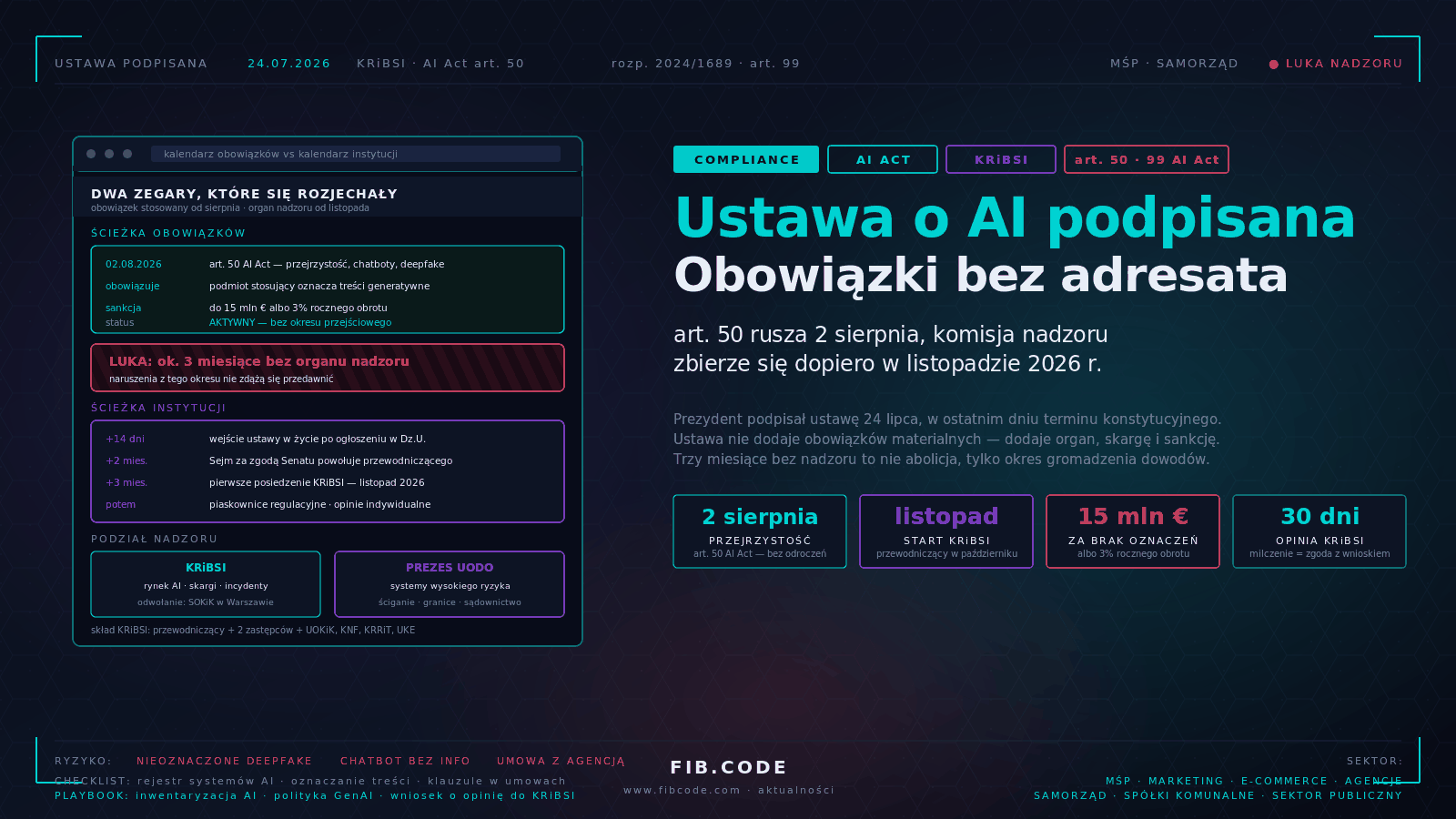
Yet 2 August 2026 remains a live compliance date — and in several respects a more important one than it was in the original timetable. On that day the regulation becomes fully applicable, the supervisory and penalty architecture starts to operate, and the transparency obligations in Article 50 cover every chatbot on a public authority's website and every model-generated image in a company newsletter.
What really starts to apply on 2 August 2026
The AI Act entered into force on 1 August 2024, but its provisions apply in stages. Since 2 February 2025 the prohibitions on unacceptable practices in Article 5 and the AI literacy obligation in Article 4 have applied. Since 2 August 2025 — the obligations of providers of general-purpose models. 2 August 2026 is the moment at which, under Article 113, the regulation becomes applicable in full as a matter of principle.
In practice this means three things. First, Member States must have designated and operational market surveillance authorities and notifying authorities — in Poland that role will be taken on by the Commission for the Development and Security of Artificial Intelligence, which we come to shortly.
Second, the provisions on administrative fines start to apply: up to EUR 35 million or 7% of annual worldwide turnover for breaching the prohibitions in Article 5, up to EUR 15 million or 3% of turnover for breaching the remaining obligations, and up to EUR 7.5 million or 1% of turnover for supplying incorrect information to the authorities. Third — and this is the change most keenly felt by an ordinary organisation — the transparency requirements in Article 50 start to apply.
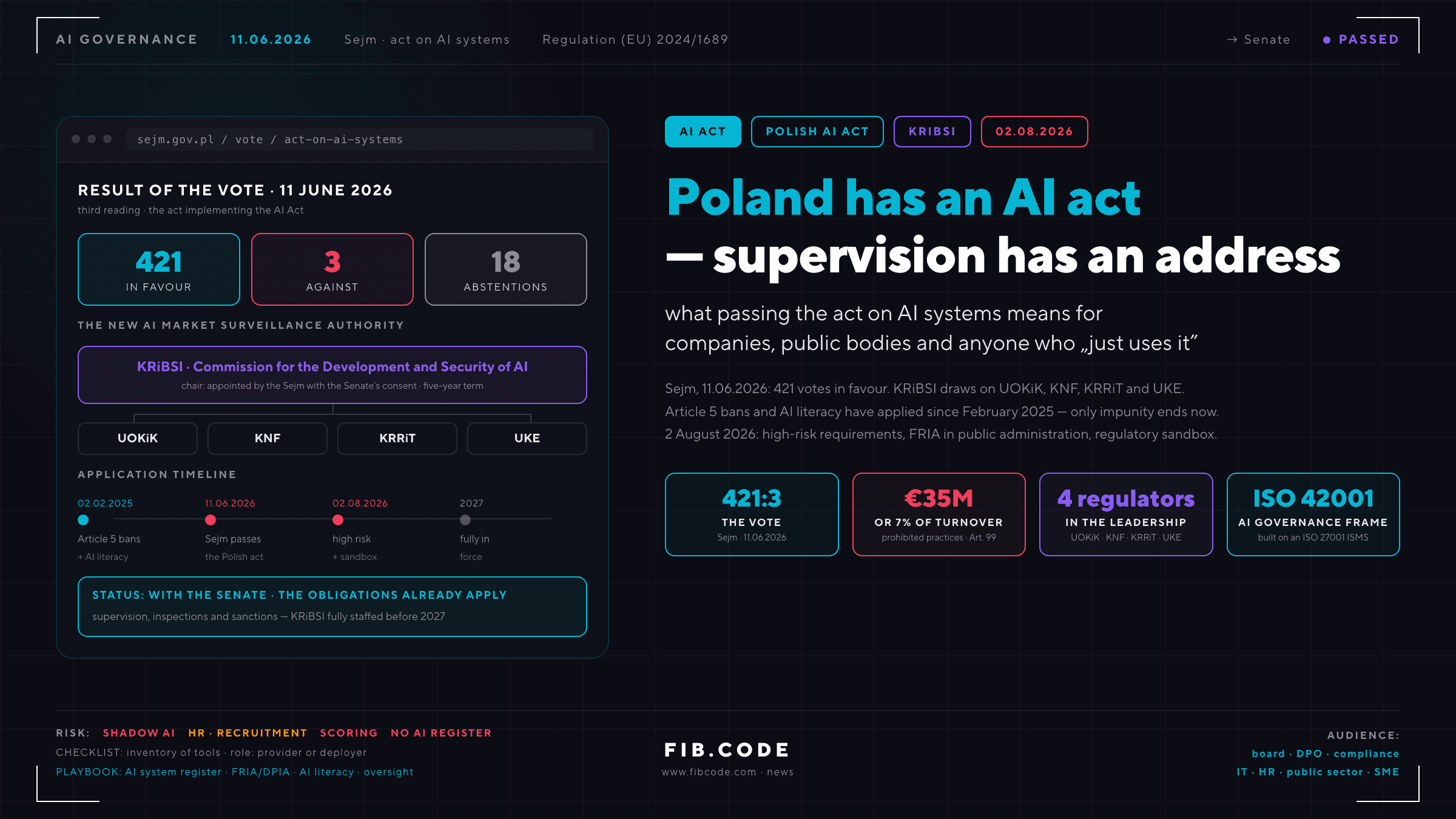
The prohibitions in Article 5 have formally applied for eighteen months, but until now breaching them in Poland carried no concrete consequences, because there was no authority, no procedure and no penalties. From August that gap disappears. If anyone has spent a year and a half running a social scoring system, subliminal manipulation or untargeted scraping of facial images, counting on a provision without an enforcer being nothing more than a declaration — the time for a change of course has just run out.
The omnibus: what was actually deferred, and on what terms
The European Commission presented the package of changes to the AI Act on 19 November 2025, as part of a broader review of digital regulation that we described when the GDPR changes were announced. The first trilogue round on 28 April 2026 ended in failure, political agreement was reached on 6 May, the Council confirmed it on 13 May, and the formal legislative path closed in June: the European Parliament voted the text through on 16 June, the Council on 29 June.
The most important deferrals look as follows. The obligations for stand-alone high-risk systems under Annex III — including systems used in recruitment, credit scoring, education, law enforcement and border control — will start to apply on 2 December 2027 instead of 2 August 2026. AI systems embedded in sector-regulated products under Annex I, such as medical devices, machinery and vehicles, have been given a deadline of 2 August 2028.
The obligation for Member States to establish regulatory sandboxes has been moved to 2 August 2027. Instead of the conditional mechanism originally proposed by the Commission, which would have made the start of the obligations dependent on the readiness of harmonised standards, fixed dates were adopted.
The omnibus is not only about postponements, however. A new prohibition has been added to Article 5 covering systems that generate non-consensual intimate imagery and child sexual abuse material — with a transitional period until 2 December 2026. Importantly, the prohibition will cover not only tools created for that purpose but also general-purpose generators, where such an outcome is foreseeable and reproducible and the system lacks effective technical safeguards. The legal basis for processing special categories of data for the purpose of detecting and correcting bias — until now reserved for providers of high-risk systems — has been extended to all AI systems and models.
The AI Office has also been strengthened: it has gained exclusive supervisory competence over systems built on general-purpose models where the model and the system come from the same provider, together with powers of investigation, on-site inspection and imposing fines. The AI literacy obligation in Article 4 has been softened in drafting: organisations are to "support the development" of their staff's competence rather than guarantee a particular level of it — which changes little in practice, because you still have to be able to demonstrate that you are doing something in this area.
Finally, there is a caveat that many commentators forget: the new dates will only become binding once the amendment is published in the Official Journal of the EU. Until that moment the original timetable formally applies. Publication before 2 August is all but certain, but an organisation that builds its compliance plan on press releases rather than on published legal acts does so at its own risk.
Article 50, or transparency: the obligation nobody deferred
The transparency obligations in Article 50 of the AI Act become applicable on 2 August 2026 as originally planned — the omnibus added only a four-month transitional period for machine-readable marking, until 2 December 2026, for systems placed on the market before that date. It is worth spelling out exactly what this involves, because it is the provision with the broadest practical reach in the entire regulation.
Providers of systems intended to interact directly with people must design them so that the user knows they are talking to a machine — unless this is obvious from the context. Every chatbot and voicebot serving customers or residents falls squarely within this requirement. Providers of systems generating synthetic audio, images, video or text must mark the outputs in a machine-readable format, so that they can be identified as artificially generated.
Deployers of systems generating deepfakes must disclose that the content has been artificially generated or manipulated. Deployers of emotion recognition or biometric categorisation systems must inform the people concerned. And AI-generated text published in order to inform the public on matters of public interest requires disclosure — which should interest anyone who uses a model to generate press releases and news items for a public authority's website.
Technically, machine-readable marking means embedding metadata or watermarks in the content that can be read and verified automatically — the industry is converging on content provenance standards, and the largest model providers declare compliance at API level. The catch is that responsibility does not end with the provider. The deployer that generated, processed and published the content must know whether the marking survived its own production process: export from a graphics tool, compression on the website, pasting text into a CMS. In practice this means reviewing the entire publication chain, not merely buying a "compliant" tool.
For an organisation that has spent the last two years rolling out content generators, customer assistants and correspondence automation, Article 50 therefore means a specific audit: where in our processes is synthetic content created, who is its provider and who the deployer, and do we have the technical means to mark it. This is precisely the area in which shadow AI — the uncontrolled use of tools by employees — stops being merely a data leakage problem and becomes a regulatory one. An employee who generates images on a private account and publishes them on the employer's channels creates a regulatory obligation the organisation knows nothing about.
KRiBSI: the Polish law completes the puzzle
The EU regulation applies directly, but without national legislation there is no authority, no procedures and no sanctions. The Polish act on artificial intelligence systems completed the entire path in under four months: the government adopted the bill at the end of March, it reached the Sejm on 9 April, the chamber passed it on 11 June with the votes of 421 members, the Senate tabled twenty-five amendments on 25 June, the digital affairs committee considered them on 2 July, and on 3 July the Sejm concluded its work. We wrote about the act itself and its consequences at greater length after the June vote — here let us simply recall the architecture.
At the heart of the act is the Commission for the Development and Security of Artificial Intelligence, or KRiBSI for short — the national AI market surveillance authority and the single point of contact with EU institutions. It will include representatives of UOKiK, the KNF, the KRRiT and UKE, and its chair will be appointed by the Sejm with the Senate's consent for a five-year term.
The Commission will conduct proceedings, monitor the market and impose fines within brackets aligned with the regulation. The act also provides for regulatory sandboxes — controlled testing environments under state supervision, conceived as support for companies developing AI systems before they bring them to market.
The coincidence of dates is no accident: the act is meant to make it in before 2 August, so that Poland does not enter full application of the AI Act without a supervisory authority — as happened to us with NIS-2, where the delay in transposition was measured in years. If the President signs the act in July, KRiBSI will start taking shape around the cut-off date.
The first months will inevitably be a period of building structures, but experience with Poland's data protection authority (UODO) teaches that supervisory authorities more than make up for a slow start — and proceedings opened in the third year of operation concern infringements from the first.
Two authorities, one infringement: the AI Act meets GDPR
There is one more dimension to the August date that attracts surprisingly little comment: the overlap of regimes. The overwhelming majority of AI systems used in Polish organisations process personal data — the chatbot serving a resident, the assistant drafting replies to correspondence, the tool analysing CVs. This means that a single deployment is subject to both the AI Act and GDPR in parallel, and a single infringement can trigger two independent sets of proceedings: before KRiBSI and before the President of UODO. Fines under the two regimes do not cancel each other out.
The practical consequence is that AI Act compliance cannot be built in isolation from existing data protection documentation. The data protection impact assessment under Article 35 GDPR and the fundamental rights impact assessment under Article 27 of the AI Act often concern the same system and the same risks — a sensible organisation runs them as one process with two outputs, rather than commissioning two separate exercises from two teams that have never met.
Likewise, the register of AI systems should grow out of the record of processing activities, and the clauses agreed with AI tool vendors out of existing data processing agreements. The President of UODO, for that matter, is not waiting for KRiBSI: enforcement decisions to date show that where large-scale automated processing of data is involved, the authority is willing to reach for Articles 5, 25 and 32 GDPR regardless of whether we call the system artificial intelligence or ordinary software.
Local government: a chatbot on a council website is the AI Act too
For local government units, the most common point of contact with the AI Act will not be any high-risk system but the prosaic chatbot on the authority's website, the voicebot in the resident service centre, and content generated for bulletins and social media. All of this falls under Article 50 from 2 August. The authority is usually a deployer here, but it can also be a provider within the meaning of the regulation — if it commissioned a system under its own brand or substantially modified it.
The second local government thread is systems that look innocent today but land in the high-risk category under Annex III: tools supporting decisions on social assistance benefits, systems scoring candidates in public-sector recruitment, algorithms allocating places in institutions. Their obligations have been postponed to 2 December 2027, and for high-risk systems already in use by public authorities Article 111 of the regulation provides an additional adjustment horizon running to August 2030 — but a fundamental rights impact assessment, documentation and human oversight are not a quarter's work.
A local authority that inventories its systems this year and classifies them by risk will be tying up the details in 2027. One that starts in October 2027 will be buying off-the-shelf "implementations" — and we know how that ends, because we watched exactly that scenario play out with GDPR in 2018.
Third thread: the regulatory calendar for local government in the second half of 2026 is merciless. Self-registration in the list of essential and important entities under the amended Polish NIS-2 implementing act (the KSC Act) runs until 3 October; obligations concerning risk analysis and incident reporting run in parallel; and from 2 August AI transparency is added on top. That is three regimes at once, usually handled by the same single IT officer and the same secretary. Without an organisational decision — who owns the AI topic in the authority — none of these deadlines will look after itself.
SMEs: you are a deployer, even if you do not know it
In small and medium-sized companies, the prevailing belief is that the AI Act concerns "the model people" — OpenAI, Google, perhaps the largest integrators. In fact the regulation also imposes obligations on deployers, that is, on every organisation using AI systems in a professional capacity. A company whose marketing team generates images and text with generative models, whose salespeople use an AI assistant in their correspondence and whose recruiter uses a CV pre-screening tool is a deployer at three different points in the regulation.
From 2 August, two areas are the most urgent. The first is the transparency described above: a customer service chatbot must introduce itself, a deepfake in an advertising campaign requires disclosure, and synthetic content requires marking on the tool provider's side.
The second is procurement hygiene: since the obligations for high-risk systems take effect in December 2027, the contracts being signed right now with HR, finance and scoring software vendors should include undertakings on AI Act compliance, technical documentation and support with risk assessment. A vendor that cannot say today whether its product will be a high-risk system under Annex III is issuing its customers an invoice with a deferred payment date.
A separate phenomenon that purchasing decision-makers should be alert to is the flourishing market in express "AI Act compliance". Paradoxically, deferring the high-risk obligations has intensified the sales narrative of urgency: offers of compliance certificates that the regulation does not provide for, off-the-peg AI policies for a few hundred zloty, and training courses promising full preparation in a single afternoon.
It is worth asking providers of such services three questions: which provisions and deadlines does their offer rest on after the omnibus; in which role — provider or deployer — do they see our organisation for each system; and what evidence of compliance will remain once their work is done. The answers usually tidy up the market faster than any regulation.
There is a third area too, less regulatory and more practical: the security of the tools themselves. AI agents integrated with corporate email and documents are a new attack surface — we wrote about this at greater length in the context of prompt injection vulnerabilities. Compliance with Article 50 will not protect a company whose AI assistant can be talked into sending the customer database to an attacker's address.
A calendar worth pinning above your desk
After the omnibus, the AI Act timeline looks as follows — and it is worth memorising it in this version, because material predating the amendment is still in circulation. Since 2 February 2025 the prohibitions on unacceptable practices and the AI literacy obligation have applied. Since 2 August 2025 — the obligations of providers of general-purpose models. On 2 August 2026 the regulation becomes fully applicable: Article 50 transparency, supervisory authorities, fines.
On 2 December 2026 the transitional period ends for content marking by systems already on the market and for the new prohibition on generators of intimate content and CSAM. On 2 August 2027 the deadline for establishing national regulatory sandboxes expires. On 2 December 2027 the obligations for stand-alone high-risk systems under Annex III begin to apply. On 2 August 2028 — for AI systems embedded in regulated products under Annex I. And in parallel, outside the AI Act but within the same budget and on the same shoulders: 3 October 2026 is the deadline for entry in the list of essential and important entities under the amended KSC Act.
Seen from this angle, it is clear that the omnibus gave nobody a holiday. It gave time — and that is an entirely different currency. Eighteen months to December 2027 is exactly what is needed for a proper inventory, classification, adjustment of contracts and building oversight of high-risk systems. Organisations that spend that time waiting will meet in November 2027 in the same queue for the same consultants, paying high-season rates.
Why Fib.Code will prepare your organisation for the AI Act
At Fib.Code we have worked for years at the intersection of regulation and information security practice: we run compliance audits, implement management systems to ISO 27001 and ISO 22301, serve organisations as an outsourced data protection officer (DPO) and information security officer, and support essential and important entities with NIS-2 and the amended KSC Act. We treat the AI Act as another layer of the same system — not a separate religion, but a set of obligations that has to fit together with what the organisation already has: the record of processing activities, risk analysis, supplier management and incident handling.
We work to three principles. First, we start from an inventory of the actual state of affairs, not from a policy template — because an artificial intelligence document that nobody applies protects only its author, and even then poorly. Second, we classify systems by real regulatory and business risk, so that the budget goes where the fines and incidents are, not where vendor marketing shouts loudest. Third, we finish every implementation by training the people who will have to live with it — from the board, through the IT officer, to the people who publish content.
The result of our support with implementing the AI Act requirements is not a binder for a KRiBSI inspection but an organisation that knows which AI systems it uses, in what role it acts in relation to each of them, what it must disclose to users from 2 August, and what it has planned for December 2027 — with evidence that can be put on the table in front of the supervisory authority, an auditor and its own board.
What to do this week, before the calendar does it for you
There are barely four weeks left until 2 August, and part of that falls in the holiday season. This week, call one meeting — the board together with the person responsible for IT and the person responsible for communications — and answer five questions between you. First: which AI systems do we actually use, including tools employees use without formal approval?
Second: where in our channels is a chatbot, a voicebot or another form of interaction with a machine operating — and does the user find out about it? Third: what content do we generate with models and publish externally, and who is responsible for marking it? Fourth: which of our systems might fall under Annex III — recruitment, scoring, benefits — and what do the contracts with their vendors say about compliance? Fifth: who, by name, owns the AI topic in the organisation, and to whom do they report?
If the answer to two or more of these questions is "we don't know", this is exactly the moment to bring in outside support and obtain a quote for the necessary work — while the deadline is still working for you rather than against you.
Get in touch: l.grabowski@fibcode.com | fibcode.com/en/contact. Directly related material: The Sejm has passed the AI act — KRiBSI, fines, obligations for companies, The Digital Omnibus and the announced GDPR changes, The AI Act and information security — how the new regulations intersect — together they form a roadmap for AI compliance for 2026–2028.